Inguinal and Femoral Hernia Repair
Summary:
- Inguinal and femoral hernias, referred to as groin hernias, are very common.
- We can treat these with a laparoscopic surgery to assist with a faster recovery.
- Price: up to $500 with adequate Private Health Insurance (self-pay options are available)
Inguinal and Femoral Hernias
Inguinal and femoral hernias, referred to as groin hernias, are very common. Approximately 10,000 hernia operations are performed in Victoria each year.
Inguinal hernias occur in up to 10 percent of males but are much less common in females. Femoral hernias are more common in women than men but are, overall, much less common than inguinal hernias.
The most serious complication of groin hernias is strangulation. This occurs when a segment of the bowel is caught in the hernia and becomes obstructed or even gangrenous — medical attention must be sought immediately. This complication is more common in femoral hernias.
Hernias never cure themselves and almost always require surgery for repair.
Inguinal and femoral hernias are together known as groin hernias, and the operation is often searched for as hernia surgery, groin hernia repair or laparoscopic mesh repair. Our Melbourne surgeons repair these hernias with keyhole surgery in private hospitals. If you are looking for repair of a hiatus hernia, which occurs at the diaphragm rather than the groin, see our hiatus hernia repair page.
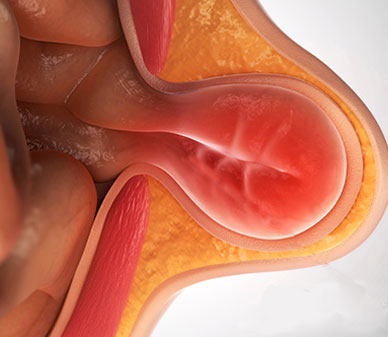
Hernia Symptoms: When to See a Surgeon
The most common sign of a groin hernia is a lump or bulge in the groin, which may appear when you stand, cough or lift and disappear when you lie down. Many hernias also cause an ache or dragging sensation that worsens through the day or with physical activity, though some cause no pain at all.
Because hernias never cure themselves and carry the risk of strangulation, any new groin lump should be assessed. If a hernia suddenly becomes painful, hard or irreducible, or is accompanied by nausea and vomiting, seek medical attention immediately, as this can indicate strangulation.
Hernia Surgery Recovery Time
Keyhole hernia repair is usually performed as a day procedure or with a single overnight stay, confirmed with you at your consultation. Most patients are up and walking the same day, many return to desk based work within one to two weeks, and heavy lifting is generally avoided for around four to six weeks while the repair strengthens.
Your surgeon will tailor this timeline to your job, your fitness and the repair performed, and both sides can be repaired in the same operation where hernias are present on both, without significantly extending recovery.

The team at LapSurgery Australia are recognised for their exceptional and major contribution to the Government sponsored Bariatric Safety Registry (BSR). The BSR tracks surgical complications and provides an unbiased safety record for weight loss surgery.
Related Procedures
Robotic Surgery
Many hernia repairs are performed robotically for enhanced precision and faster recovery.
Learn moreHiatus Hernia Repair
A different type of hernia occurring at the diaphragm, often linked to reflux.
Learn moreGeneral Surgery
View all general surgery procedures we offer across Melbourne.
Learn moreYour Next Steps
Ready to take the next step? Here is how to get started.
Frequently Asked Questions
Common questions about hernia repair surgery
Keyhole hernia repair is routine surgery performed through three small incisions, usually as a day procedure or single overnight stay, with most patients walking the same day. All surgery carries some risk, which your surgeon will discuss with you, but recovery is far quicker than the open operations of the past.
With adequate private health insurance, out of pocket costs are up to $500, with separate accounts from the assistant surgeon, anaesthetist and hospital depending on your fund and excess. The Medicare item number is 30609. Self pay options are available, and full informed financial consent is provided before surgery. Contact us for a full written estimate.
No. Hernias never cure themselves and almost always require surgery for repair. Delaying repair risks the hernia enlarging and, in the worst case, strangulation, which is a surgical emergency.
Most patients are walking the same day, return to desk based work within one to two weeks, and avoid heavy lifting for around four to six weeks. Your surgeon will tailor the advice to your job and your repair.
Yes. One advantage of the keyhole approach is that hernias on both sides can be repaired through the same small incisions in a single operation, which is especially beneficial for recovery.
A groin hernia (inguinal or femoral) is a bulge of tissue through the abdominal wall in the groin. A hiatus hernia occurs internally, where the stomach pushes through the diaphragm, and typically causes reflux rather than a visible lump. We repair both, on separate pages of this site.
Have more questions? We're here to help.
Contact us for more informationTake the Next Step
Ready to start your journey? Fill in your details below and we'll be in touch to schedule your consultation.
Address
Gladstone Road Consulting Suites 327 Gladstone Road Dandenong North, VIC 3175
Phone
(03) 9760 2777Office Hours
Monday – Friday: 9:00 AM – 5:00 PM Saturday – Sunday: Closed